Descendants acquire works of enslaved potter in landmark restitution deal
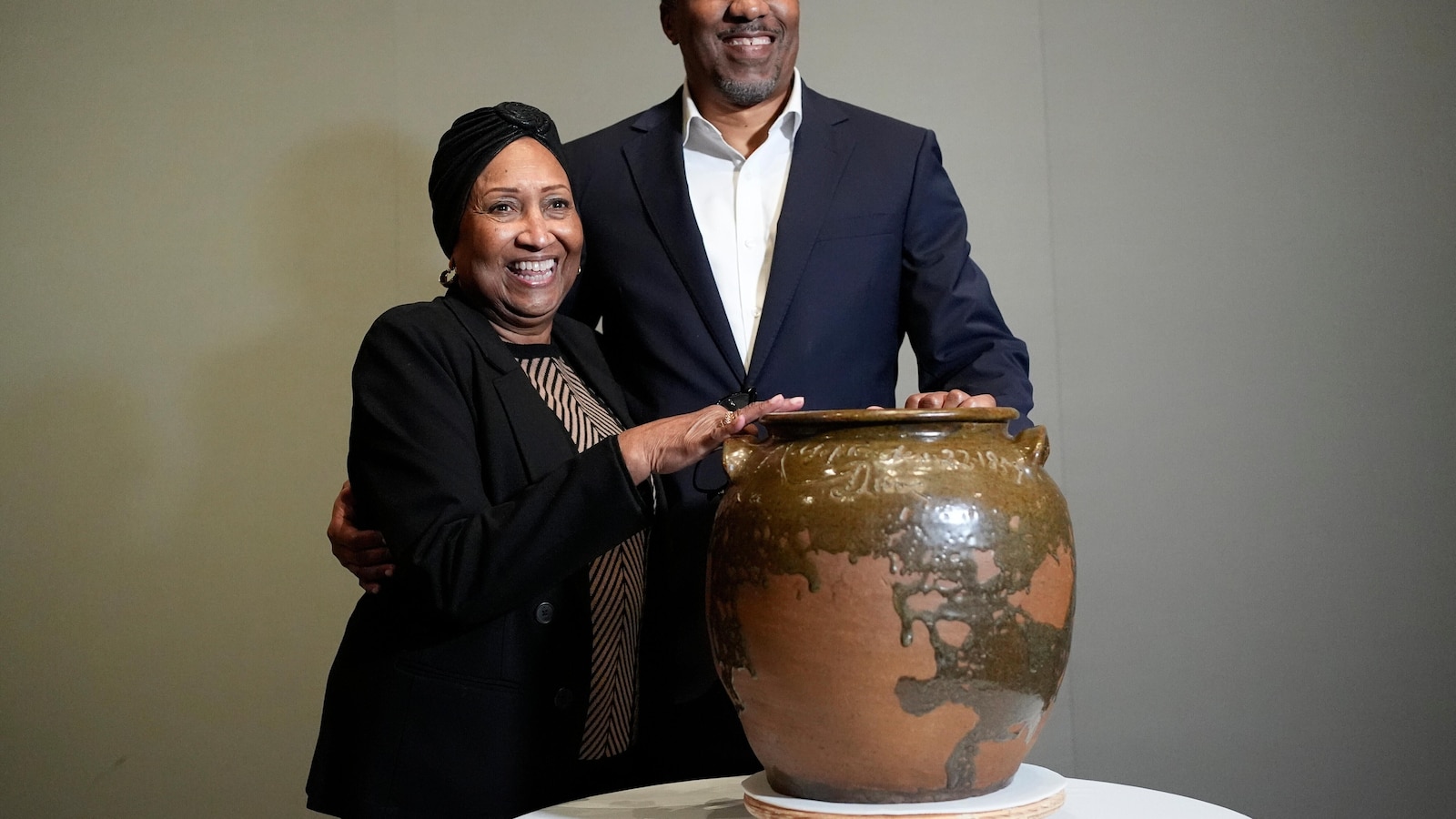
BOSTON — Contained in the broad mouth of a stoneware jar, Daisy Whitner’s fingertips discovered a slight rise within the clay — a mark she hoped was a hint left behind by her ancestor, an enslaved potter who formed the vessel almost 175 years in the past in South Carolina.
Standing within the gallery of the Museum of Wonderful Arts in Boston final week, Whitner stated she felt a quiet connection to her ancestor, David Drake, in that second.
“I used to be telling the children, ’Inside this jar, I’m certain I’m feeling his tears, sweat drops off his face, his arms,’” stated 86-year-old Whitner, a Washington, D.C., resident and a retired account supervisor for The Washington Submit.
The jar is considered one of two returned to Drake’s household as a part of a historic settlement this month between Drake’s descendants and the Museum of Wonderful Arts in Boston, one of many establishments that holds items of his work.
The vessels are amongst tons of of surviving works by “Dave the Potter,” an enslaved man who labored within the alkaline-glazed stoneware potteries of Edgefield, South Carolina, within the a long time earlier than and through the Civil Struggle. Dave signed a lot of his jars — and inscribed some with rhyming couplets — a unprecedented and unparalleled assertion of id and authorship throughout a time when literacy for enslaved individuals was criminalized.
The settlement represents what consultants say is the primary main case of artwork restitution involving works created by an enslaved individual within the U.S. — a course of historically related to households searching for the return of artwork looted by the Nazis in World Struggle II.
It’s additionally uncommon: as enslaved individuals had been denied authorized personhood and documentation, tracing the possession or lineage of their works is commonly inconceivable.
Kids’s guide creator Yaba Baker, Dave’s 54-year-old fourth-generation grandson, known as the return “a non secular restoration.” Baker, whose first two kids’s books discover Black historical past, stated the household felt a twin sense of satisfaction and grief. Many Black households, he famous, battle to hint their ancestry previous a number of generations; recovering Dave’s work gave them again a chunk of themselves.
After the museum returned the pots to the household, they bought one again so individuals can proceed to be taught from Dave’s legacy. The opposite is on lease to the museum, no less than briefly. The MFA Boston stated it would not disclose how a lot it paid.
“We don’t wish to cover them away in our home. We would like different individuals to be impressed by it,” Baker stated. “We would like individuals to know that this individual, Dave the Potter, who was informed he was nothing however a instrument for use, realized he had humanity. He deserved his personal identify on his pots. He deserved to put in writing poetry. He deserved to know who he was.”
Laboring within the pottery yards within the South Carolina warmth, Dave etched his identify subsequent to the date — July 12, 1834 — on a clay jar that might be bought by his proprietor and used to retailer pork and beef rations for enslaved individuals like him throughout the area.
He additionally inscribed the jar, which might seemingly find yourself on a cotton plantation in South Carolina, with the couplet:
“Put each bit all between / Absolutely this jar will maintain 14” to mark the jar’s 14-gallon capability.
The vessel was the primary of tons of, if not hundreds, of stoneware jugs and jars made by Dave alongside different enslaved potters over 50 years earlier than and through the Civil Struggle.
A lot of Dave’s poetry adopted Christian themes. As he aged, he wrote extra and explored themes associated to his enslavement. One in every of his most resonant poems was etched right into a jar he produced in 1857, across the time students consider Dave and his household had been separated after being bought to completely different slave homeowners.
“I ponder the place is all my relation / friendship to all – and each nation”
A number of Drake descendants stated they felt particularly moved by Dave’s query about his relations — and that their restitution felt like Dave’s query was lastly answered.
It’s unclear what grew to become of the jars after Dave died. The MFA bought them in 1997 from an artwork seller. MFA Boston’s Artwork of the Americas Chair Ethan Lasser stated he thinks they survived largely from pure “benign neglect” in South Carolina as a result of they had been giant and troublesome to move or break.
The MFA has no less than two Drake pots, a “Poem Jar” and a “Signed Jar,” each from 1857.
The jar the Drake descendants bought again to the museum is much like the 1857 pot on which Dave asks about his relations as a result of he makes use of first-person language that means possession — one thing that makes it particularly highly effective, Lasser stated.
“Consider this as an enslaved individual, talking within the first individual claiming authorship,” Lasser stated.
Within the poem, Dave writes:
“I made this Jar = money – / although its known as = lucre Trash”.
On a couple of pot, Dave writes “and Mark” subsequent to his personal identify, suggesting he labored on the piece with one other enslaved laborer. Oral histories point out that Dave was disabled after dropping a leg, though it is unclear how, and will have wanted assist along with his ceramic work later in life.
His final surviving jar, made because the Civil Struggle raged on in 1862, reads: “I made this Jar, all of cross / When you don’t repent, you may be misplaced”.
Researchers consider Drake died someday within the 1870s after gaining his freedom within the Civil Struggle. He’s accounted for within the 1870 census, however not within the 1880 census.
For the Drake descendants, encountering Dave’s work has been each shifting and troublesome — a collision of satisfaction in his artistry and grief for the situations by which he lived.
Yaba Baker, who has a 17-year-old daughter and 13-year-old son, stated the expertise gave his household one thing that they had by no means had earlier than: a traceable hyperlink.
“I used to be capable of flip to my son and say, ‘That is your lineage.’ Dave the Potter was not solely an incredible artist — he resisted oppressive legal guidelines, despite the fact that he might have been killed for it,” he stated. “That’s what you come from. Earlier than, we didn’t have that hyperlink.”
Yaba Baker stated he usually thinks in regards to the anguish Dave could have felt if, as some historians speculate, the poems on his jars had been makes an attempt to sign to members of the family bought away from him — a standard trauma of slavery.
“I can’t think about not figuring out the place my very own children are,” Baker stated. “Finishing that circle could be very shifting for me.”
For his mom, Pauline Baker, discovering Dave’s story crammed a void many Black households know intimately.
“When you’re not African American, you don’t perceive the lacking hyperlinks in your historical past,” she stated. “While you do discover a connection, it turns into very private.” She research his life — the warmth, the labor, the lack of a limb — and wonders how he managed such precision and focus. “He didn’t enable them to enslave his thoughts,” stated Baker, 78, a retired speech pathologist who labored for 3 a long time in Washington, D.C., public faculties.
For the reason that MFA settlement was introduced, the household has heard from museums and personal collectors who maintain Dave’s work and wish to focus on what moral restitution may appear like for them as nicely.
Daisy Whitner stated she felt her ancestor’s presence every time she slid her hand contained in the jar.
“It broke my coronary heart,” she stated. “The surface is gorgeous, however when you concentrate on what he went via — sunup to sunset, in that South Carolina warmth, on one leg — this poor man in bondage had no say in working so exhausting for nothing.”
Supply hyperlink