Zanzibar is seeing a seaweed growth. Can the ladies amassing it money in?
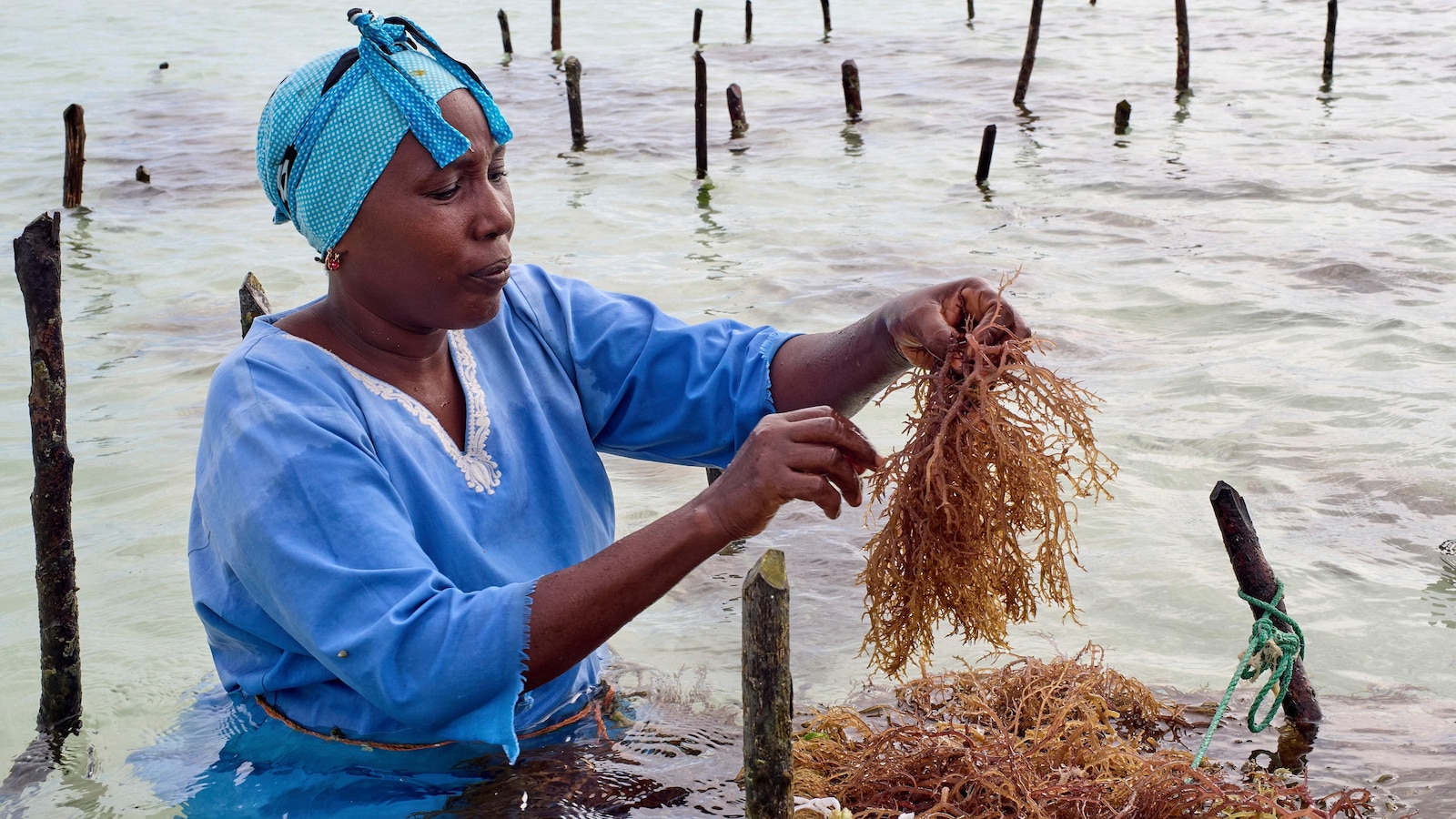
ZANZIBAR, Tanzania — The ladies wade with baskets close to the seashores, their colourful clothes a magnet for vacationer cameras. Sunscreen worn by the holidaymakers could even include the product the ladies are amassing: Zanzibar’s seaweed.
An eco-friendly native business that employs 1000’s of girls, the seaweed farming seems to be like an image postcard — even when the truth of the work is grimmer than what meets the attention.
“I expertise ache in my again, waist and chest because of the labor within the sea. There are additionally dangers of being stung or bitten,” stated one farmer, Mwanaisha Makame Simai. “Typically sturdy waves sweep you away. I’ve personally witnessed three instances of individuals drowning.”
Seaweed has been farmed off Zanzibar, a part of Tanzania’s Indian Ocean coast, for many years however there’s a new growth underway as international demand will increase.
Seaweed is primarily exported to the worldwide meals, cosmetics and pharmaceutical industries, which extract their thickening and stabilizing brokers.
In Zanzibar, personal funding and donor {dollars} have been growing. Seaweed is the third largest contributor to the native financial system after tourism and spices.
“Ten years in the past, individuals thought you have been loopy for working in seaweed,” stated Klara Schade, director at Mwani Zanzibar, which describes itself as a boutique seaweed farm and manufacturing facility within the village of Paje. “Now it’s turn into a buzzword.”
Mwani even runs seaweed excursions in Paje to introduce the work.
For the federal government of the semi-autonomous archipelago, seaweed is on the coronary heart of its “blue financial system” initiative to drive progress from sustainable marine and coastal sources.
Cargill, one of many world’s largest commodity buying and selling companies, invested an unspecified quantity in Zanzibari seaweed in 2020 in a partnership with The Nature Conservancy, with a view to enhancing yields and farmers’ incomes.
Different nongovernmental organizations have stepped up funding, together with the International Seaweed Coalition, which oversees the protection and sustainability of the sector because it scales up.
Most of Zanzibar’s 25,000 seaweed farmers are girls, notable in a society the place fewer than half of girls are employed, based on a authorities census taken in 2021.
The Related Press spoke with 5 of the ladies, who described generally harsh working circumstances within the guide labor. The overwhelming majority of seaweed farmers work independently or in collectives, promoting to native middlemen. There are few if any protections.
Lengthy days are spent wading beneath the equatorial solar. Again aches and pores and skin irritation may result, with stings from sea urchins or different creatures being one other fear.
“There are well being and security challenges on this work,” stated Simai, an unbiased farmer who stated she makes round $50 monthly to assist help her small household of two. The work could also be more difficult for these with bigger households, she stated.
“It’s not a straightforward job, it’s tiresome,” stated Pili Khalid Pandu, 43, who works for Mwani, doing rotations between its manufacturing facility and amassing within the sea.
A brand new threat has come lately from rising sea temperatures.
“Local weather change is forcing girls to enter deeper water” for optimum assortment, stated Mhando Waziri, challenge supervisor for blue financial system initiatives on the nonprofit Milele Zanzibar Basis.
Milele’s applications embody instructing girls seaweed farmers to swim, with a view to fight what Waziri known as a rising drowning disaster.
The hope for the sector, as with many pure useful resource industries in Africa, is making extra of the availability chain native. That is the objective at Mwani Zanzibar, the place Schade has centered on coaching seaweed farmers in cosmetics manufacturing.
Staff at Mwani spend extra of their time in its Paje workshop and fewer within the sea. Schade stated Mwani’s high-end cosmetics — a bottle of its “face and physique pores and skin superfood” sells on-line for $140 — imply its employees make way over the common seaweed farmer. She wouldn’t give particulars.
“Empowerment is giving them the means and the choices to proceed additional,” Schade stated.
Fauzia Abdalla Khamis, 45, stated she has progressed from farm employee to supervisor within the manufacturing facility throughout greater than a decade.
Milele additionally has applications to assist girls develop merchandise out of seaweed, principally cosmetics. Waziri estimated they will fetch 10 instances as a lot cash domestically because the uncooked, unprocessed product.
“Loads of companions wish to interact extra in seaweed,” Waziri stated. “However individuals elevate the problem: ‘If a program comes right here, how will it profit farmers?’”
Simai expressed concern that seaweed farmers like her are too far down the worth chain to profit from the brand new investments within the native business.
“A lot of the cash finally ends up with those that have workplace jobs, somewhat than the hardworking farmers,” she stated.
___
For extra on Africa and growth: https://apnews.com/hub/africa-pulse
___
The Related Press receives monetary help for international well being and growth protection in Africa from the Gates Basis. The AP is solely answerable for all content material. Discover AP’s requirements for working with philanthropies, a listing of supporters and funded protection areas at AP.org.
Supply hyperlink