Three years after liberation, Ukraine’s Kherson faces one other sort of siege
KHERSON, Ukraine — A lot of the streets of Kherson are empty now. Three years after the liberation ended a nine-month Russian occupation, town that after erupted in pleasure has sunk right into a cautious stillness — a spot the place each day life unfolds behind partitions or underground.
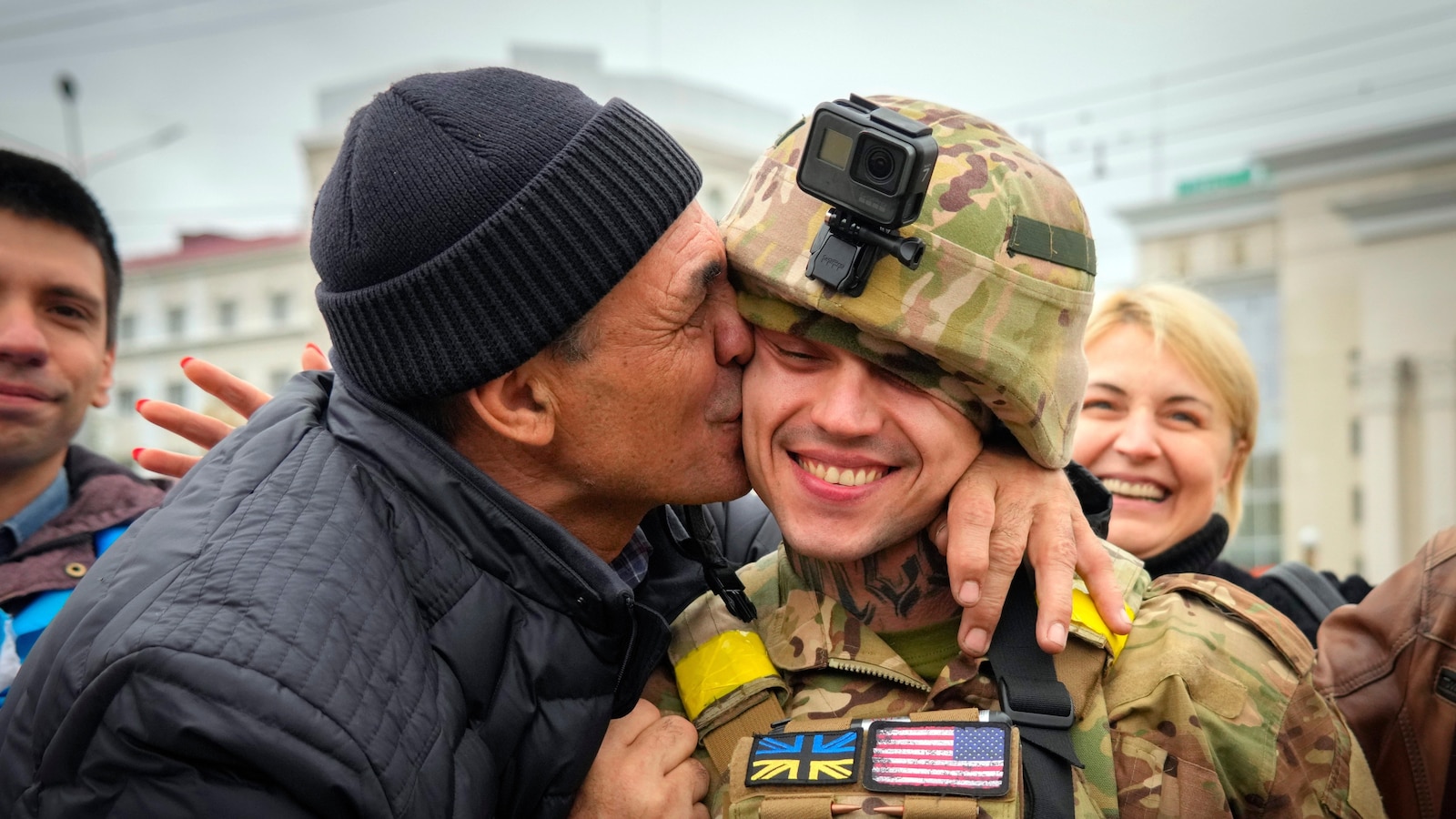
On Nov. 11, 2022, folks poured into the principle sq. of the southern Ukrainian port metropolis, waving blue-and-yellow flags and embracing the troopers who had freed them after the months underneath Russian management. They believed the worst was over.
As a substitute, the conflict modified form. From throughout the Dnipro River, Russian troops strike with common depth — and drones now prowl the skies above a metropolis of damaged home windows and empty courtyards.
Nonetheless, those that stayed insist that even the life in a principally empty and shuttered metropolis is simpler than residing underneath Russia.
A latest go to by Angelina Jolie was a welcome morale increase for residents whose each day problem to outlive was highlighted by photographs exhibiting the American actor in a basement and on a avenue shielded by slim corridors of mesh overhead, wanted to guard civilians from drones.
As soon as dwelling to just about 280,000 folks, Kherson has change into a forgotten stretch of the entrance line, the place explosions echo each day beneath billboards that also learn: “Metropolis of energy, freedom and resilience.”
The small flower kiosk of 55-year-old Olha Komanytska stands out in opposition to the bomb-scarred heart of Kherson. Her purple and white roses spill from tall buckets — a surreal burst of colour on a nook that after drew regular crowds however now sees only some clients.
“Hardly anybody buys flowers,” she says. “We’re simply attempting to make it by means of.”
For practically 30 years, Komanytska and her husband grew flowers in Kherson’s countryside. The kiosk is all that’s left after their greenhouses had been destroyed.
She wears a black scarf to mourn him. He died of a coronary heart situation, however she believes the conflict pushed him towards it.
Her eyes fill with tears as she speaks of him, and she or he admits she will’t keep lengthy at his grave. “No more than 5 minutes,” she says, including that it’s due to drone hazard.
However at her stand, the safety isn’t any higher. As soon as, a shell flew proper over her head. She survived solely as a result of she bent down, she says, pointing to the pane of cracked glass she later coated to cover the harm.
Like many in Kherson, Komanytska has realized town’s new guidelines of survival. She will be able to inform each weapon by its sound — artillery, rockets, bombs — however drones, she says, are the worst. She now closes early and walks dwelling pressed to the partitions, generally hiding underneath timber to flee their “eyes.”
She mimics the sound — a low, screeching whine. “They’re at all times looking” for a goal, she says. “At night time I stroll dwelling, and so they’re above me. You simply run. Earlier than, you would cover underneath timber. Now … I don’t know the place to cover.”
The one time her somber face softens right into a smile is when she remembers town’s liberation. “That day was superb,” she says, repeating the phrase a number of instances, as if to make it actual once more.
On a crisp autumn day, yellow leaves collect on the mesh above the road as municipal employees stretch extra nets — the identical plastic mesh as soon as used on development websites, now repurposed to protect civilians from drones.
At one hospital, the doorway is wrapped totally in protecting netting — alongside the edges, overhead and across the perimeter, with solely a slim passage left for employees and sufferers. Officers say such websites, the place civilians collect in massive numbers, are high priorities as a result of they’re usually focused.
Regardless of the fixed stress, a petrifying alertness within the air, town stays alive. Put up workplaces nonetheless function, although their entrances are blocked by concrete slabs meant to soak up blasts. At bus stops, the place transport continues regardless of the dangers, small cement bunkers stand prepared — reminders that shelling can come at any second.
Above the nets, an invisible protect protects Kherson. It is town’s digital warfare methods that use radio alerts to detect, jam or disable enemy drones.
Max, 28, who declined to present his full title for safety causes, serves within the 310th Separate Marine Digital Warfare Battalion, which is chargeable for the digital protect over Kherson and the area. He has labored in digital warfare for two-and-a-half years as the sphere has grown more and more important.
His front-line publish appears extra like a programmer’s workspace: pc screens show maps and knowledge feeds whereas voices from neighboring items echo by means of the room.
Max stated the job is to detect targets and ensure they fail their missions — whether or not “drones looking civilians, infrastructure, autos and even humanitarian convoys.”
He says as much as 250 FPV drones can head towards Kherson in simply half a day. But Max’s unit intercepts greater than 90% from his gamer-style workstation.
“Once you see a strike hit a soldier or a civilian, it hurts you — it weighs in your soul. You wish to do all the things doable to ensure it by no means occurs,” he stated, including they’ll additionally intercept stay feeds from Russian drones and watch their operations in actual time.
“I feel they merely wish to destroy us as a nation — not simply the army, however everybody — in order that we stop to exist.”
To protect a way of regular life, some actions — particularly for youngsters — have moved underground. Former residence basements at the moment are cozy rooms with carpets and colourful decorations.
As soon as every week, a youngsters’s membership gathers right here to play chess and checkers, small tables filling the room as children give attention to their subsequent transfer, snicker and wander freely beneath posters about respiratory strategies if nervousness begins.
Chess coach Oksana Khoroshavyna says that in peacetime, coaching can be stricter, however for the previous two years the membership has been principally a spot the place Kherson’s youngsters can meet and make associates.
“These children keep dwelling on a regular basis,” she says. “They examine on-line; all the things of their lives is distant.”
Till not too long ago, they might nonetheless journey to tournaments in Mykolaiv, the place they spent each free minute outside — one thing they’ll not do in Kherson. Now even these journeys have stopped: The street out and in has change into too harmful.
In one other basement, 16-year-old Artem Tsilynko, a highschool senior who hopes to check dentistry, practices boxing together with his friends.
“For me, this place is about unity,” he says. “Though life in Kherson is so restricted — social life, sports activities life — we nonetheless have an opportunity to coach.”
He has spent practically 1 / 4 of his life in conflict and says concern for his personal life has dulled with time — however nonetheless returns at night time throughout heavy shelling. “Once you’re sitting within the basement, your coronary heart races,” he says. “After that, it’s laborious to go to sleep.”
___
Comply with AP’s protection of the conflict in Ukraine at https://apnews.com/hub/russia-ukraine
Supply hyperlink